After my recent talks on Claude, the question I keep getting isn’t “does Claude write good code?” It’s: “how do I get Claude to work the way our team works?” Every organization has conventions — how you structure services, which libraries you’ve standardized on, the review nits your seniors always leave, the deployment checklist that lives in a Confluence page nobody reads. That’s the tribal knowledge new hires spend months absorbing. It’s also exactly what a generic AI assistant flattens out.
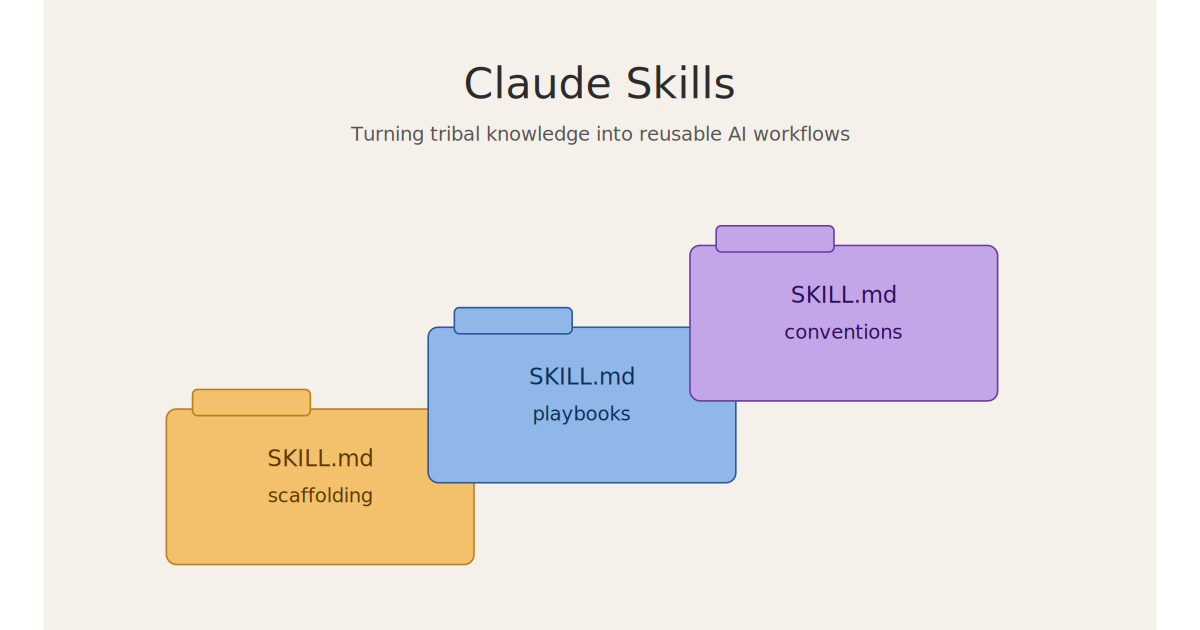
That’s the gap Claude Skills are designed to fill. A Skill is a folder containing a SKILL.md file and any supporting assets — templates, scripts, checklists — that Claude loads on demand when the task matches. Think of it as a runbook your AI teammate actually reads before touching the keyboard.
Where Skills earn their keep
Three places I’d start:
Scaffolding. A Skill that encodes your standard project layout, logging and observability setup, and the Dockerfile your platform team actually accepts. New services stop drifting from the template on day one.
Review conventions. A Skill that captures the feedback your senior engineers always give — naming, error handling, logging levels, the patterns you’ve agreed on. Claude applies them before a PR ever reaches a human reviewer.
Operational playbooks. A Skill with your rollout checklist: staging steps, feature flags, rollback criteria, who to notify. The institutional memory that usually lives in a wiki page half the team has never opened.
The tradeoff to watch
Skills are powerful precisely because they encode opinions — which means a stale Skill is worse than no Skill. Treat them like any other code artifact: version them in Git, review changes, retire the ones that no longer reflect how you actually work. The failure modes rhyme with every shared library we’ve ever maintained.
Where to start this week
Pick one friction point — the thing a new hire always gets wrong on their first day — and write it up as a single SKILL.md. Keep it under a page. Use it for a sprint. Iterate. The goal isn’t a library of fifty Skills; it’s one Skill that earns its keep, then another.
Skills are how you stop re-explaining your team to Claude every morning — and start treating it like someone who already works here.