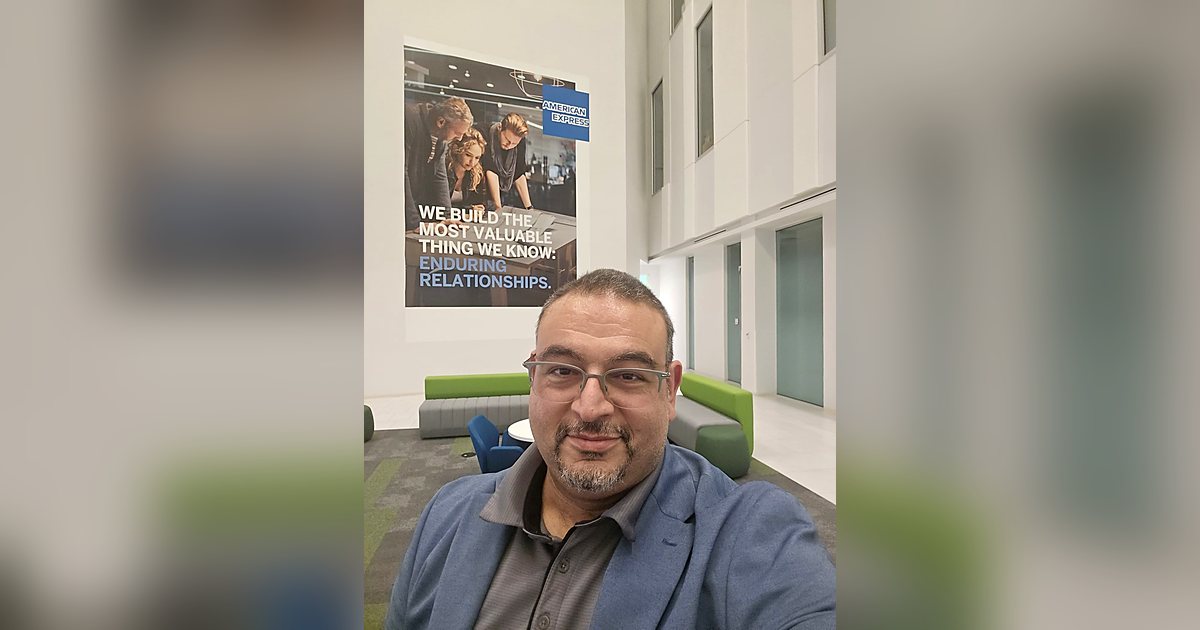
There are evenings that remind you why you got into this field in the first place. Last night was one of them. I spent it at the American Express regional campus in Sunrise, in a room full of engineers, leaders, and practitioners who are actively building the future of AI at one of the most recognized brands in the world — and I left with my notebook full and my expectations reset.
What follows is part recap, part reflection on what I learned about how American Express thinks about AI, the culture behind it, and why the people in that room seemed so genuinely energized about what they’re building.
The presentation: from ideation to implementation
The evening opened with a presentation grounded in the same ideas the team has written about publicly in Reimagining Software Delivery with AI. The core message landed clearly: the race to adopt the “best” model will never end, so the more useful question isn’t which model tops a benchmark — it’s how do we use AI to actually deliver value?
Rather than bolting an AI assistant onto the coding step and hoping for magic, the team has reimagined the entire software development lifecycle as four connected phases:
- Envision + Define — turning ambiguous ideas into structured, prioritized capabilities.
- Verify + Specify — converting validated features into implementation-ready specifications.
- Build + Integrate — translating validated intent into production-grade software.
- Test + Release — delivering with confidence rather than hope, then feeding production learnings back into the next idea.
The insight I keep coming back to is that the biggest gains don’t come from writing code faster. They come from achieving clarity earlier — reducing ambiguity at the front of the lifecycle so the whole system accelerates, not just one step of it. One figure that stuck with me from the broader conversation: a roughly 30% reduction in development effort when this approach is applied with discipline.
The vision and direction: reinvention, done right
If I had to capture the keynote in a few words, it would be reinvention and transformation — done right.
That last part matters. This is a company operating across many countries, serving a massive customer base, in a heavily regulated industry. The speaker framed it as the responsibility that comes with great power and reach: you don’t get to move fast and break things when millions of people trust you with their financial lives. AI here is built with guardrails technology and a clear commitment to alignment with the company’s value system and goals.
A few themes ran through the whole talk:
- A successful AI developer learns the business first. The technology is necessary but not sufficient — the engineers who break through are the ones who understand alignment, communication, listening, and the real challenges of the people they’re building for.
- Ownership and evolving go together. Nobody framed AI as a finished destination. It’s a discipline of continuously seeing challenges, taking ownership, and evolving.
- It’s everywhere, not siloed. This isn’t a single AI team off in a corner. Every area of the organization is actively using, exploring, and learning about AI. When adoption is that broad, the learning compounds across the whole company instead of staying trapped in one group.
- Scaling AI is the real challenge. It’s one thing to demo a model in a sandbox; it’s another to scale AI responsibly across a global, regulated enterprise serving millions of customers. The hard part isn’t a single use case — it’s making AI dependable, governed, and consistent everywhere it touches the business.
- The best is yet to come. The team isn’t claiming victory. They were candid that AI is already growing strong here — I spoke with multiple practitioners actively implementing it at scale — and that they’re still early in what’s possible.
The use cases: growth, innovation, and fraud protection
The conversations about real applications were some of my favorite of the night. The use cases spanned innovation and growth, but fraud protection stood out — it’s a place where AI’s pattern recognition translates directly into protecting customers and earning trust. When your AI has to operate across many countries and experiences, trust isn’t a nice-to-have; it’s the product.
The culture: putting people first
Here’s the part that genuinely surprised me, because it’s easy to talk about and hard to live.
The culture at American Express — anchored in their Blue Box Values — puts colleagues at the forefront of innovation. And it’s not just a slogan on a wall. It shows up in concrete ways:
- People first. Colleagues are given the tooling to do their best work, plus some of the best benefits I’ve heard described, designed to help them excel personally and innovate professionally.
- Selective by design. There’s a deliberate intent to be selective — to bring in people who will keep the culture rolling rather than dilute it.
- Top-notch everything. The expectation is excellence across the board, paired with a real investment in growth and development.
- Giving back. A massive investment in community development was mentioned more than once — the sense that success carries an obligation to the world outside the campus.
This is the engine behind the AI work. The motivation to stay and grow at a place like this isn’t just compensation; it’s being trusted with meaningful problems, given great tools, and surrounded by people who keep raising the bar.
What I’m taking with me
I walked in curious about American Express’s AI strategy. I walked out thinking about culture.
The strategy is impressive — a reimagined lifecycle, real guardrails, measurable impact, AI engineers paving the way. But the thing that makes it work is the order of operations: learn the business, align with the values, put people first, then let the technology amplify all of it. AI doesn’t replace judgment, accountability, or ownership here. Those stay deeply human.
If the best really is yet to come — and the room certainly believed it was — then nights like this are how you build toward it: one honest conversation at a time, with people who care about doing things right.
A sincere thank you to everyone at the Sunrise campus who made the evening so worthwhile. I left inspired, and I’m already looking forward to what comes next