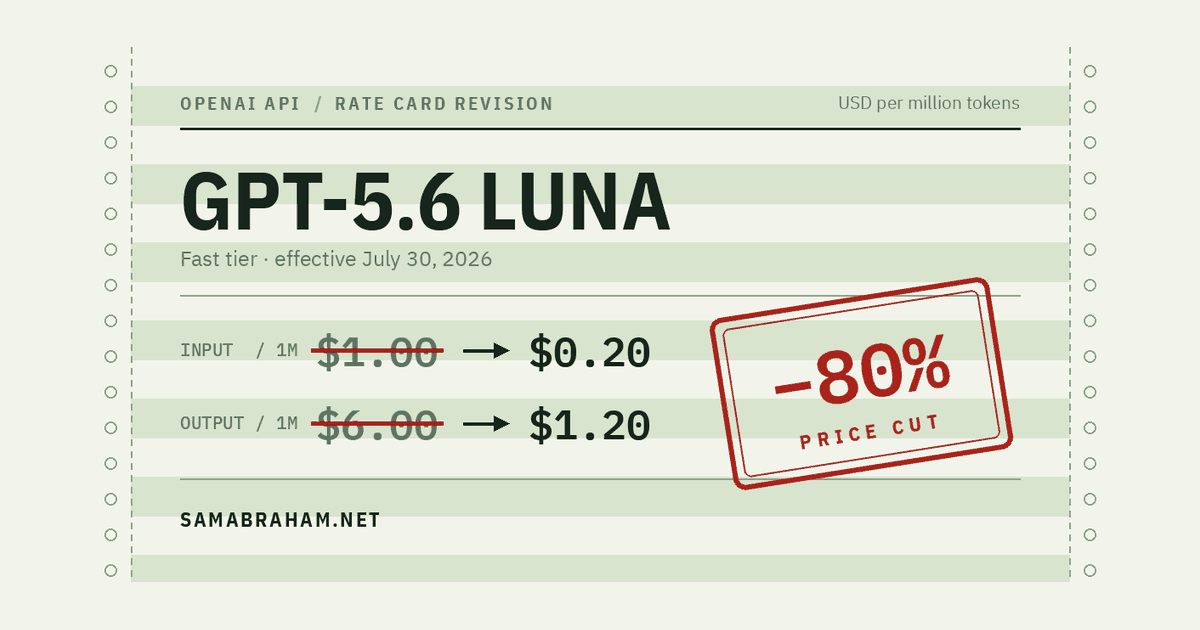
On July 30, OpenAI cut the price of GPT-5.6 Luna by 80% and GPT-5.6 Terra by 20%. A week later, on August 6, Luna became the default model for every ChatGPT Free and Go user, with unlimited text chats.
Those two announcements landed a week apart and got covered as separate stories. They’re the same story. And if you’re making architecture decisions about where AI fits in your stack, it’s worth about twenty minutes of your attention.
Let me start by clearing up a bit of confusion I’ve seen in how this is being repeated.
What the 80% actually refers to
The 80% is a cut against Luna’s own previous price, not against competing models. Luna went from $1.00 / $6.00 per million input/output tokens to $0.20 / $1.20. Same model, one-fifth the cost, effective immediately.
That distinction matters because it changes what you do with the information. It isn’t a promotional discount you need to catch before it expires. It’s a permanent repricing of a model you may already have in production — which means your existing bill dropped by 80% on July 30 whether you noticed or not.
Go look at your July invoice. Seriously. If you’re running Luna anywhere, the back half of that month should look different from the front half.
Where that puts Luna against the field
Here’s the current budget and mid-tier landscape, per million input/output tokens:
| Model | Input | Output |
|---|---|---|
| Gemini 2.5 Flash-Lite | $0.10 | $0.40 |
| DeepSeek V4 Flash | $0.14 | $0.28 |
| GPT-5.6 Luna | $0.20 | $1.20 |
| Claude Haiku 4.5 | $1.00 | $5.00 |
| Gemini 3.6 Flash | $1.50 | $7.50 |
| Claude Sonnet 5 | $2.00 | $10.00 |
| GPT-5.6 Terra | $2.00 | $12.00 |
| Claude Opus 5 | $5.00 | $25.00 |
| GPT-5.6 Sol | $5.00 | $30.00 |
Note what this table does not say: Luna is not the cheapest model available. Gemini 2.5 Flash-Lite undercuts it on input, and DeepSeek V4 Flash undercuts it on both — and V4 Flash ships under MIT open weights, so you can self-host it.
What changed is Luna’s position. It moved from sitting near Haiku 4.5 in the budget tier to sitting well below it, while keeping OpenAI’s tool-calling and Responses API stack. If you were already on the OpenAI platform and choosing between tiers on cost, the calculus you did in June is stale.
Run the math on a real workload
Abstract percentages don’t drive decisions. Numbers on your own pipeline do.
Take a document classification and extraction pipeline pushing 200M input tokens and 20M output tokens a month — a realistic volume for an enterprise ingest process:
- Luna, today: $64/month
- Luna, before July 30: $320/month
- Haiku 4.5: $300/month
- Gemini 3.6 Flash: $450/month
- Sonnet 5: $600/month
- Terra: $640/month
- Sol: $1,600/month
That’s a $256/month swing on one pipeline from a price change you didn’t have to lift a finger for. Multiply it across a portfolio of automations and it becomes a line item somebody in finance will notice.
But run your own numbers rather than borrowing mine. Token counts vary enormously by tokenizer, and vendors have been changing tokenizers between releases — Anthropic has noted that models from Claude 4.7 onward produce roughly 30% more tokens for identical text. A model that looks 20% cheaper on the rate card can be more expensive in practice. Measure tokens on the model you actually plan to deploy.
Also stack the discounts before you commit: batch APIs typically run 50% off, and prompt caching can cut repeated-context costs dramatically. Those levers often matter more than the sticker price.
The architectural point, which is the real one
The interesting shift here isn’t the price. It’s what the price makes structurally possible.
For the last couple of years, the sensible pattern was: route everything to a mid-tier model, escalate the hard stuff to a flagship, and use the cheap tier only for genuinely trivial work — classification, routing, extraction. The cheap tier was where you sent things that didn’t need to be right so much as categorized.
OpenAI’s pitch with this release is that the cheap tier now handles full agent loops — tool calls, multi-step workflows, tests. They cite production customers to that effect: Blitzy reported moving from a single structured-output call to a full tool-calling agent loop with Luna, and Dust reported 40% faster and 40% cheaper performance on the same agentic tasks versus their previous default.
Take vendor-supplied customer quotes for what they are. But the direction is consistent with what I’ve seen elsewhere, and it points at a design pattern worth trying: use the expensive model to decide, and the cheap model to execute.
Concretely, in a coding workflow, that looks like using Sol (or Opus, or whatever your flagship is) to resolve ambiguity and write the plan — then handing well-specified, unambiguous changes to Luna to implement, test, and evaluate. The expensive tokens go where judgment is required. The cheap tokens go where the work is already defined.
That’s not a new idea. What’s new is that the economics finally make it obviously correct rather than marginally clever.
One claim to treat carefully
OpenAI’s announcement states that on Agents’ Last Exam, Luna outperforms Anthropic’s Fable 5 at an estimated cost per task nearly 99% lower.
That’s a vendor benchmarking a competitor, on a benchmark of their choosing, with cost-per-task estimates they constructed. It may well be accurate. It has not been independently verified, and Fable 5 at $10/$50 is priced for an entirely different class of work than a $0.20 classification model. Read it as marketing until someone neutral reproduces it.
The same caution applies to every “our model beats their model” chart you’ll see this quarter, from any vendor. Build your own eval on your own tasks. It’s the only benchmark that pays your bills.
What I’d actually do this week
- Check your July invoice for the price break, and confirm your Luna usage is billing at the new rate.
- Re-run your model selection matrix. Anything you chose on cost grounds before July 30 was decided on numbers that no longer exist.
- Pick one agentic workflow currently running on a mid-tier model and test whether the plan/execute split holds up — flagship for planning, Luna for execution.
- Measure tokens, not rates. Instrument the pipeline before you migrate anything.
Prices are moving faster than architecture reviews. That’s a decent problem to have, but only if you actually revisit the decisions.
Verified against OpenAI’s July 30 pricing announcement, Anthropic’s published API pricing, and Google’s Gemini API rates as of August 12, 2026. Prices in this space change frequently — confirm current rates before budgeting.